Rwanda Reflections
I recently spent just over two weeks in Rwanda coaching cricket as part of Cricket Without Boundaries, a charity that uses sport – specifically cricket – as a vehicle for social change. It has taken me a while to write these reflections, partly because the experience itself had so many layers that it resisted a neat summary. The days were intense, the encounters varied, and the country itself difficult to reduce to any single narrative. Writing about it now feels less like recounting an event and more like slowly piecing together what those two weeks actually meant.
Many people have asked why I chose to go in the first place. A few years ago, I spent time in Nepal on a similar programme, and that experience stayed with me long after it ended. I have always loved cricket, but what interests me more than the sport itself is what it enables — confidence, discipline, rigour, empathy, and sometimes a sense of possibility that might otherwise be missing.
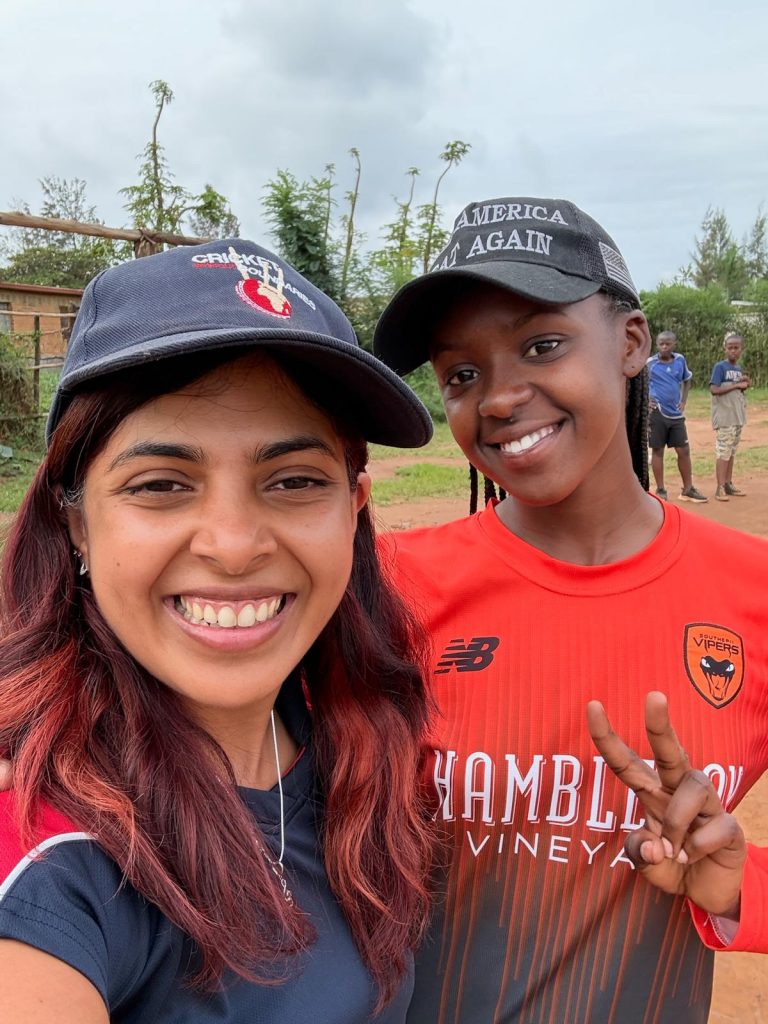
There was also a more personal motivation. Diversity and inclusion in sport matter deeply to me. As a female person of colour, representation is not an abstract concept; it shapes what people believe they can do. Cricket Without Boundaries creates opportunities to expand that sense of possibility, particularly for girls who may not otherwise see themselves represented in sport.
Ironically, my own awareness of women’s cricket came surprisingly late. I did not realise that cricket was played professionally by women until 2017 (after finding out the India had reached the World Cup finals) — something that now feels almost absurd given that I grew up in cricket-obsessed India and in what I would describe as a fairly feminist household. But discovering that gap also strengthened my resolve to contribute to the sport in whatever small ways I could.
Experiences like this also offer something tourism rarely does: immersion. When you are coaching hundreds of children every day, working alongside local coaches, travelling between schools and community fields, you begin to see a country differently. The rhythms of daily life become visible in ways that are hard to observe from the outside.
Somewhere in the middle of the trip, I found myself asking a slightly uncomfortable question: was cricket actually the reason I was there? In hindsight, cricket was simply the entry point. It was the excuse that allowed us to move through communities, to meet people, and to glimpse the social fabric of a country that is often discussed but rarely understood in depth.
The Numbers — and What They Don’t Capture
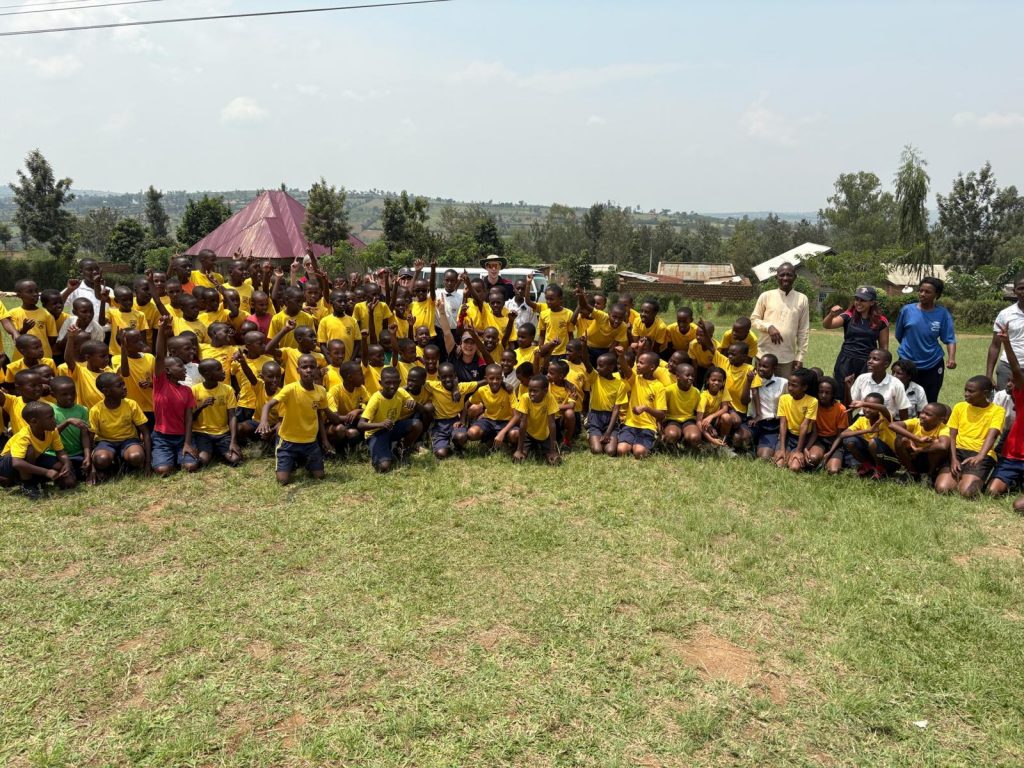
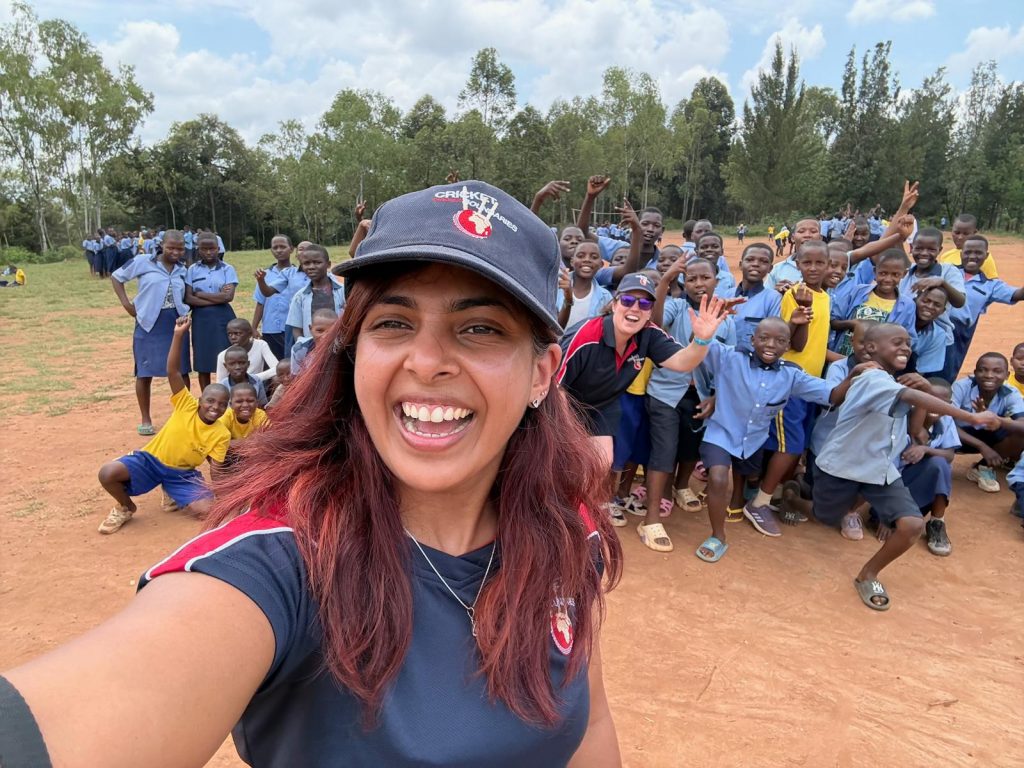
From a programme perspective, the statistics sound impressive. Over the course of two weeks, we coached roughly 3,800 children, almost evenly split between boys and girls.
Numbers like that make for a good headline, but they do not really capture the experience itself. Coaching sessions varied wildly in scale and energy. Some involved 100+ children learning to hold a bat for the first time; others saw hundreds of students crowding onto a dusty field, curious about a sport they had never encountered before.
But the numbers were not the story. The real story began with the country itself.
The first thing most visitors notice about Rwanda is how strikingly beautiful it is. The landscape is made up of rolling hills and thick greenery, but the physical environment is only part of what stands out. The roads are remarkably clean, the cities orderly, and Kigali in particular feels – at moments – more structured than several parts of developed nations.
Rwanda is often described as the cleanest country in Africa, and the description feels accurate almost immediately. Yet beneath that surface order lies a history that remains deeply present.
The genocide of 1994, in which nearly one million people were killed in roughly one hundred days, sits quietly in the background of the country’s modern identity. The violence was intimate and devastating – neighbours turning against neighbours, communities collapsing under the weight of ethnic division.
For me, the history felt particularly close because a former colleague and friend had survived the genocide. Conversations with him were part of what initially made me curious about Rwanda, and part of why I wanted to experience the country directly rather than through headlines or documentaries.
Rwanda today has rebuilt itself in ways that many observers describe as remarkable. Infrastructure, governance, and public order have all improved significantly over the past three decades. Yet rebuilding is not the same as healing, and that distinction becomes clearer the longer you spend there.
A Country Defined by Youth
One statistic that frequently appears in discussions about Rwanda is that the average age of the population is around nineteen, which may also be a part of the impact of the genocide. Spending time with thousands of schoolchildren makes that statistic feel very real.
The country feels young – energetic, competitive, and full of restless ambition. The children we coached were intensely enthusiastic – many were determined to win even before fully understanding the rules of the game.
But that youthfulness also hints at something more complex. A population so young reflects, in part, the demographic consequences of the country’s recent history. Entire generations were disrupted or lost, leaving behind a social structure that is still rebuilding itself.
At the same time, Rwanda has created strong mechanisms for collective rebuilding. One example we encountered unexpectedly was Umuganda, the nationwide community service day that takes place on the last Saturday of every month.
On that morning, much of the country pauses its normal activities so citizens can contribute to communal work – cleaning streets, repairing infrastructure, or maintaining public spaces. Our team discovered this the hard way when we were unable to leave the town we were in (Nyagatare), raising mild panic about whether we would miss our flights.
Yet watching communities participate together made the policy feel less like an obligation and more like a social ritual.
Teaching a Sport That No One Knows
Cricket itself presented its own challenges. Although the sport has been growing in Rwanda, it remains unfamiliar to many children.
Teaching cricket to players who have never seen the game before requires rethinking how coaching works. Traditional drills assume some baseline understanding of the sport — something our participants often did not have.
So we were forced to simplify.
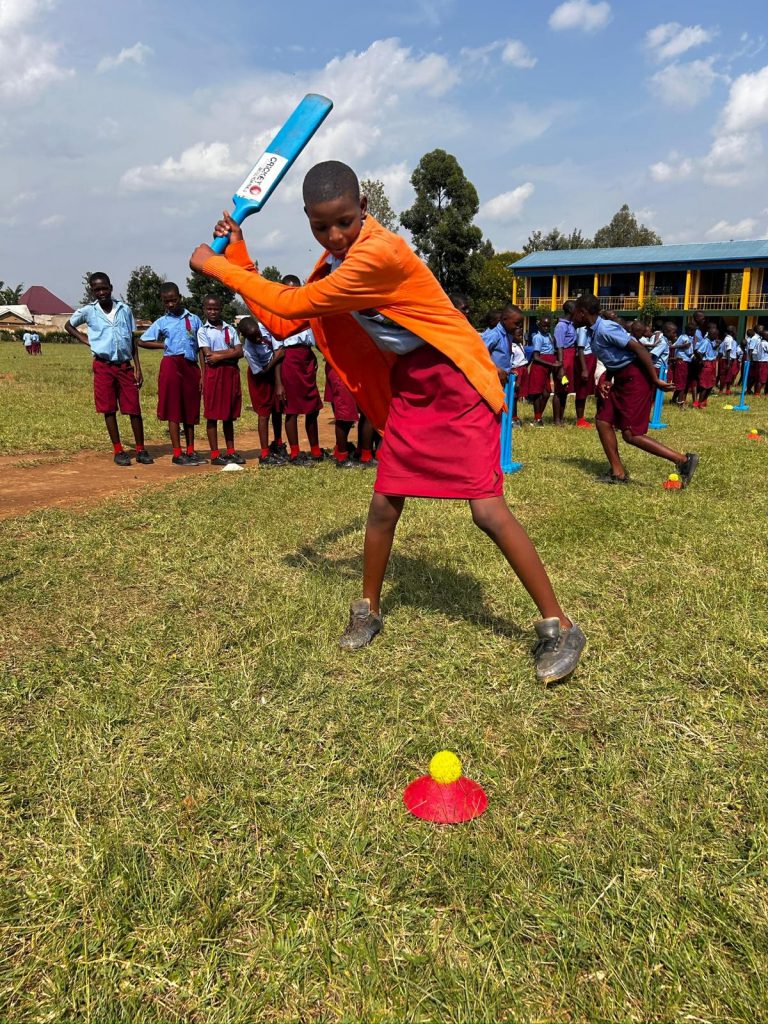
One of the most successful adaptations was a fast-paced format we called Rapid Fire, designed to emphasise batting and fielding through short, energetic rounds. The rules were simple and the pace quick (just like the name).
Repeated enough times, the structure worked. Children who had never held a cricket bat before were soon sending balls racing across the field. [Fun fact, we were all sick of rapid fire by the end of the trip. But, on our last day, we ended up running 21 rapid fire games between 3 sets of coaches. Oh yay].
Language created another layer of complexity. Many of the students spoke some English – certainly more than we spoke Kinyarwanda – but communication still relied heavily on demonstration. Coaching became visual rather than verbal: show the movement through demonstrations.
Equipment limitations added further unpredictability. On several occasions we prepared drills for 150 participants only to find that more than double that number had arrived. Adjusting quickly became part of the daily routine.
Moments That Stay With You
Beyond the coaching itself, certain small moments linger.
At one school we saw children playing basketball with a ball made from tightly wrapped plastic bags – and yes, they managed to make it bounce!
At a cricket competition, one of the team captains arrived wearing and running with only a single shoe. Later that evening we saw a group of children playing football nearby – several of them also wearing just one shoe – on their dominant foot!
Necessity, as the saying goes, is indeed the mother of invention.
Other moments challenged more subtle assumptions.
One afternoon I asked a boy his name.
“Elvis,” he replied.
“Like the singer?” I asked.
“Yes.”
“What’s your favourite song?”
“Jailhouse Rock.”
For reasons I cannot fully explain, I had assumed he would not know the song. That fleeting interaction stayed with me as a reminder that assumptions often reveal more about the observer than the person being observed.
Building Something That Lasts
Experiences like this raise an important question about sustainability. Flying into a country for two weeks and then leaving again can easily become symbolic rather than meaningful.
The real work lies with the local coaches and organisers who remain long after international volunteers depart.
We spent time with Eric, Eric (yes, there are two), Gizelle, Murielle, Ghizlaine, Sifa, Moeez, and Sammy — whose booming call of “ARE YOU READY?” became a recurring soundtrack to our sessions.
They are the ones building the future of cricket in Rwanda.
The People You Meet Along the Way
Outside the cricket fields, the trip also offered glimpses into everyday life.
Near our accommodation in Nyagatare we befriended a coffee seller whom we visited most mornings. He lives above his shop, far from his family, whom he sees only once a month because of work. The coffee he serves is excellent, and he dreams of becoming a photographer.
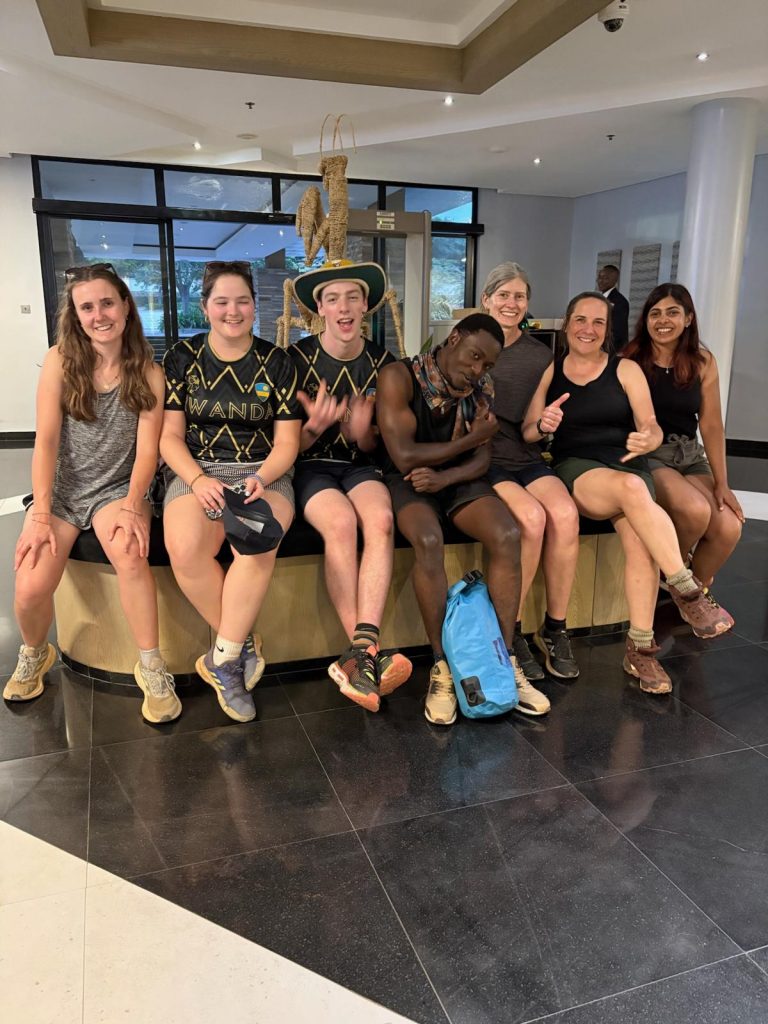
Our guide Daniel, a white-water rafting expert, took us hiking through the Busana hills — a region that barely appears on digital maps. He recently received an offer to be a rafting coach at Camp America, and he (and we) pray he gets his visa and goes there safely.
On the hike, children followed us along the trails, laughing and chasing tennis balls down the slopes. It prompted me to observe the surroundings – there was a striking sense of freedom in Rwanda: children wandering hillsides, women running small businesses confidently, with a sense of safety as an undertone of the place.
Identity, Perception, and the Space In Between
There was another layer to the experience that I am still reflecting on – what it meant to be a person of colour, and specifically an Indian, coaching in parts of Africa.
In many places we visited, the white coaches were immediately the centre of attention. Children would run toward them excitedly, shouting “Muzungu! Muzungu!” — the Kinyarwanda word commonly used for foreigners, particularly white people. The excitement wasn’t hostile; if anything, it was full of curiosity and enthusiasm. But it was also a reminder that visibility and novelty often shape how people respond to outsiders.
Being Indian occupied a more ambiguous space. The history of Indians in parts of East Africa is complex. Some are well-established business owners and part of the economic fabric of the region. Others arrive as labourers or temporary workers. Those layered histories inevitably shape perceptions, even if children themselves do not fully understand them.
Unlike in places like the UK, where discussions about race, equality, and representation are part of mainstream education, many of the children we worked with have not necessarily been exposed to those same conversations. Their reactions are shaped more by what they see around them than by formal ideas about diversity.
There were moments during the trip when I became acutely aware of that difference – standing next to my fellow coaches and noticing how differently we were perceived. None of those moments were dramatic or confrontational, but they were quietly instructive. They reminded me that identity travels with you, and that the way you are seen in the world can shift dramatically depending on where you stand.
What Sport Actually Does
Experiences like this reinforce something I have come to believe about sport.
It is rarely about the sport itself.
Instead, sport becomes a framework through which other qualities emerge — leadership, confidence, resilience, and the ability to work together toward something shared.
Cricket was simply the starting point. The real learning came from everything around it. Morikozi, Rwanda!

Be First to Comment